
How to Choose a Portable Electronic Keyboard
- Popuglobal
- Knowledge base
A portable electronic keyboard is a self-contained musical instrument. It has keys. It has built-in sounds. It has built-in speakers. And in most cases, it runs on batteries. Turn it on, press a key, and sound comes out. No computer, no external speakers, no audio interface required.
This self-contained design is what separates a portable electronic keyboard from three related products that are often confused with it. A MIDI controller has keys but makes no sound without a computer or tablet connected to it. A stage piano has weighted hammer-action keys and is built for gigging musicians who need line outputs and professional-grade piano sounds. A console digital piano is a piece of furniture. A full-size cabinet with an integrated stand and pedals that weighs over 100 pounds and stays where it is installed.
- The portable electronic keyboard is none of these. It is a lightweight, all-in-one instrument designed for learning, practice, and casual performance anywhere there is a flat surface and, optionally, six AA batteries.
- MIDI controllers, stage pianos, and upright digital pianos are not considered portable pianos.
- The five key criteria for portable keyboards: the realism of built-in sounds, key sensitivity, speaker distortion and volume, battery life, and connectivity options.
- 61 keys is the gold standard for portable electronic keyboards.
- Built-in learning tools and USB ports have completely transformed the traditional boundaries of keyboard use.
- There is no perfect keyboard in the world, only the model best suited for a specific application.
Portable electronic keyboards are the best choice for piano beginners with no prior experience. Unlike acoustic pianos, they don’t require a high purchase cost or take up much home space, nor do they need external audio input devices like MIDI keyboards. Simply place them on a desk for easy basic piano practice and playing. Next, I will explain in detail the selection tips and teach you how to choose a portable electronic keyboard that suits your needs.
Contents
Key Takeaways
- A portable electronic keyboard is a self-contained instrument with built-in sounds, built-in speakers, and in most cases battery power.
- Touch-sensitive keys are the minimum viable feature for learning to play.
- 61 keys covers the vast majority of beginner and intermediate repertoire.
- Entry-level portable keyboards start around 100 to 180 dollars.
- Choosing the right portable keyboard is more important than choosing an expensive one.
- The portable electronic keyboard is not a compromised version of a more serious instrument.
What is a Portable Electronic Keyboard?
(Image Source: Casio)
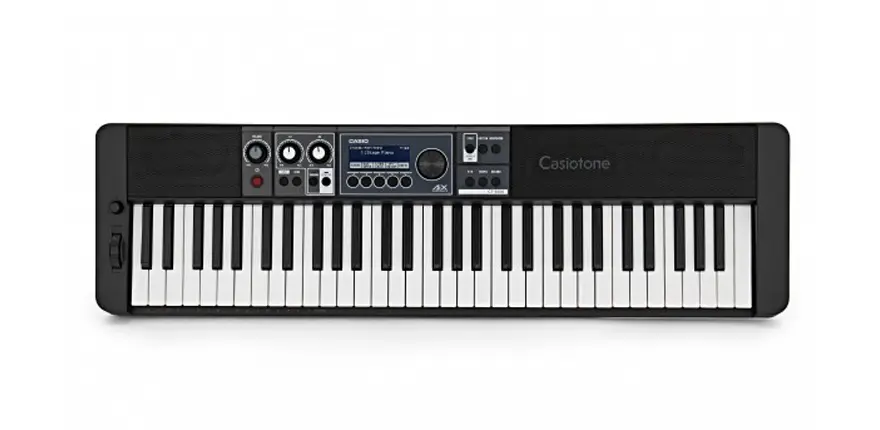
A portable electronic keyboard has four defining characteristics. It produces sound through built-in speakers or headphone output without any external equipment. It contains an onboard sound engine with multiple instrument voices that can be selected and played immediately. Pianos, organs, strings, drums, and other categories come pre-loaded and ready. It is light enough to be carried by one person, typically under 20 pounds for a 61-key model and often well under 10 pounds. And it can be powered by batteries, allowing it to operate in any location regardless of outlet availability. If an instrument lacks any of these four traits, it belongs to a different product category and should be evaluated under different criteria.
The portable electronic keyboard is sometimes called a portable arranger keyboard when it includes auto-accompaniment features. Rhythm patterns and bass lines follow the chords the player holds in the left hand and generate a full backing arrangement automatically. Not every portable keyboard has full arranger functionality, but the majority of models at the entry and mid levels include at least basic rhythm accompaniment. This distinguishes the category from stage pianos, which omit accompaniment features to focus entirely on piano performance and sound quality. A Yamaha PSR-E383 is a portable electronic keyboard. A Yamaha P-225, while portable in weight at 25.1 pounds, is a stage piano. Its design priorities are weighted hammer action and piano sound fidelity, not variety of voices or battery operation.
What a Portable Electronic Keyboard Is Not?
There are three product categories that look very similar to portable electronic keyboards, but they are not portable music keyboards. A detailed comparison below will help you understand the differences and avoid buying the wrong instrument due to its unsuitable purpose.
A MIDI controller is a keyboard-shaped device that sends note data, velocity information, and control messages to an external sound source. That source is typically a computer, tablet, or hardware synthesizer module. The controller itself has no built-in sounds and no built-in speakers. Pressing a key on a MIDI controller with nothing connected to it produces silence. Controllers like the Partykeys, Arturia KeyLab, and Native Instruments Komplete Kontrol series are tools for digital audio workstation workflows. They excel at software instrument control, beatmaking, and studio production. They are not stand-alone instruments, and a person looking for a keyboard that plays out of the box should not buy one.
Console-style digital pianos adopt furniture-grade integrated design, perfectly restoring the authentic playing feel of traditional acoustic pianos for home use. For reference, the Yamaha CLP-845 has a net weight of around 57kg (126lbs). Such instruments are positioned as fixed placement home pianos rather than portable carry-along devices. They are clearly classified as home console digital pianos, distinct from portable electronic keyboards. It is inappropriate and logically misplaced to take them as references when discussing the product.
A stage piano sits between these worlds. It has built-in sounds and line outputs for connecting to a PA system or amplifier. Many models, such as the Yamaha P-225 and Roland FP-30X, include built-in speakers, making them functionally similar to portable keyboards. They weigh 25 to 40 pounds. Portable enough for a gigging musician with a case, but substantially heavier than a 7-pound portable keyboard.
The point is that these are different tools for different jobs, and conflating them under a single “portable keyboard” label helps no one make a good decision.
| Category | Built-In Sounds | Built-In Speakers | Battery Power | Typical Weight | Key Action |
|---|---|---|---|---|---|
| Portable Electronic Keyboard | Yes | Yes | Yes | 5 to 20 lbs | Synth-action, touch-sensitive |
| MIDI Controller | No | No | USB bus power only | 1 to 13 lbs | Synth-action or semi-weighted |
| Stage Piano | Yes | Varies by model | Rare | 25 to 40 lbs | Fully weighted hammer action |
| Console Digital Piano | Yes | Yes | No | 80 to 130 lbs | Fully weighted hammer action |
Core Features of Portable Keyboards
Built-In Sounds and Voices
The number of built-in instrument voices varies widely across the category. The Casio CT-S500 pushes to 800 tones with assignable control knobs for real-time filter and effects adjustment. A higher voice count does not necessarily mean higher-quality sounds. What matters is whether the core sounds are satisfying to play. Acoustic piano, electric piano, organ, strings, and a few synth leads together cover the vast majority of what most players actually use day to day. Most players in this category spend 80 percent of their time on five or six sounds. The remaining hundreds of voices are for exploration and occasional creative use, not daily practice.
The auto-accompaniment feature found on many portable keyboards. When auto-accompaniment is active, the keyboard analyzes the chords played with the left hand and generates a full backing arrangement that follows the chord changes in real time. Drums, bass, and harmony instruments lock to whatever chord the left hand holds. A beginner playing a simple C-F-G chord progression hears a complete band responding to their left hand. For a solo player who wants to experience the feel of playing with a rhythm section, this feature adds substantial value. For someone following a structured classical piano curriculum, it is largely irrelevant. Match the feature set to the actual use case.
Touch Sensitivity and Key Feel
Touch sensitivity means the keyboard detects how hard or soft a key is pressed and adjusts the output volume accordingly. This is the single most consequential feature for anyone learning piano, because dynamics is not an advanced technique added later. The deliberate control of volume and expression through touch is fundamental to how piano music works from the very first lesson.
Nearly every portable electronic keyboard above the toy tier now includes touch-sensitive keys. If you encounter a keyboard at a very low price point that does not specify touch sensitivity, assume the keys are not touch-sensitive. These keyboards, typically selling for under 80 dollars, are functionally toys rather than learning instruments regardless of how they are marketed.
The key action on portable keyboards in this category is uniformly synth-action. A spring-loaded mechanism with no added weights keeps the keys light, responsive, and quiet. This is not a compromise in the context of the category’s design goals. A 7-pound keyboard that runs on AA batteries cannot also house a weighted hammer mechanism. The trade-off is accepted and understood. Players who require weighted keys should be looking at stage pianos, not portable arranger keyboards.
Speakers and Battery Power
The built-in speakers on portable keyboards are small by physical necessity. A keyboard that weighs 7 pounds cannot contain large speaker drivers and the enclosures needed to make them sound full. For home practice at moderate volume in a bedroom or living room, the entry-level speaker systems are adequate. For performing for more than a handful of people in a room, an external amplifier or a keyboard with line outputs connected to a powered speaker is necessary.
Battery power is not a convenience feature. It is the difference between an instrument that works wherever you are and one that works only where the room layout permits.
| Model | Voices | Speaker Power | Battery Life | Weight | Key Touch |
|---|---|---|---|---|---|
| Casio CT-S300 | 400 tones | 2.5W x 2 | 8 to 10 hours (6xAA) | 7.3 lbs | Touch-sensitive |
| Yamaha PSR-E383 | 650 voices | 2.5W x 2 | 6 to 8 hours (6xAA) | 8.8 lbs | Touch-sensitive |
| Casio CT-S500 | 800 tones | 6.5W x 2 (bass-reflex) | 6 to 8 hours (6xAA) | 10.4 lbs | Touch-sensitive |
| Yamaha NP-35 | 15 voices | 6W x 2 | 6 to 8 hours (6xAA) | 13.2 lbs | Touch-sensitive |
| Yamaha PSR-EW425 | 820 voices | 6W x 2 | 5 to 7 hours (5xD) | 18.7 lbs | Touch-sensitive |
When comparing speaker specifications, focus less on wattage numbers and more on whether the keyboard uses a bass-reflex or sealed enclosure design. A bass-reflex port, visible as a slot or opening on the bottom or rear of the keyboard, allows the small drivers to move air more efficiently and produces a fuller low end at the same wattage. The difference is immediately audible in piano and bass sounds. The Casio CT-S500 and Yamaha PSR-E383 both use bass-reflex enclosures. The entry-level CT-S300 uses a sealed design.
Key Range Guide
61 Keys
(Image Source: Yamaha)
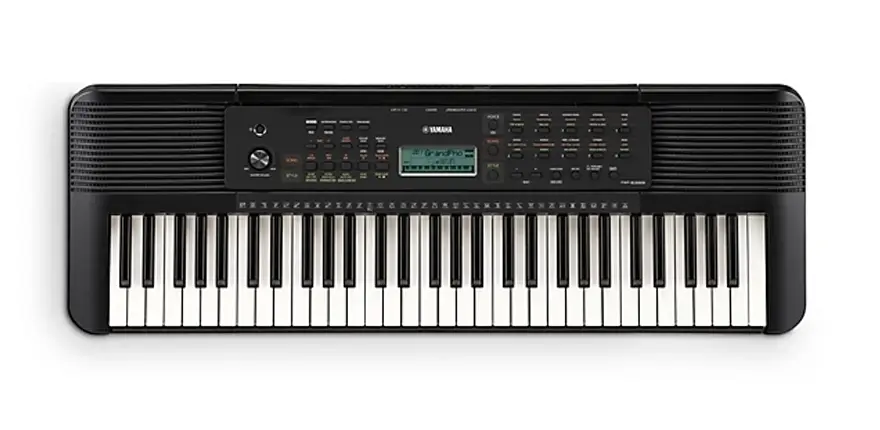
Sixty-one keys spanning five octaves is the standard format for portable electronic keyboards. This range covers the melody and accompaniment of virtually all pop, rock, country, R&B, and worship music. A student working through a standard adult beginner method book will not run out of keys within the first two to three years of study. The 61-key format also keeps the keyboard’s width to approximately 35 to 38 inches. That is narrow enough to fit on a small desk, a bedroom dresser, or the narrow shelf of an X-stand in a tight space.
76 Keys
(Image Source: Yamaha)
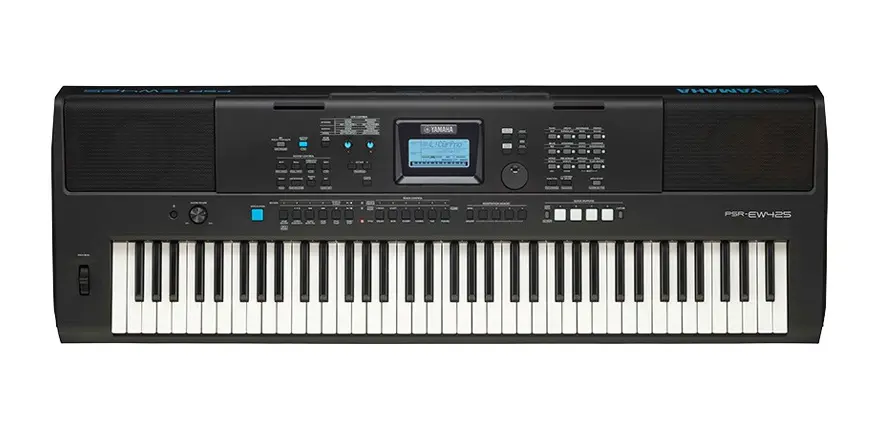
The 76-key layout strikes an ideal balance that is often overlooked. Covering a range of six-and-a-half octaves, this keyboard size fully fits most intermediate-level classical pieces as well as all mainstream popular music styles. With an overall width of 47 to 49 inches, it effectively saves 4 to 5 inches of desktop space when compared with standard 88-key full-size keyboards.
The Yamaha NP-35 is the most notable model in this size. At 13.2 pounds and 45 inches wide, it runs on six AA batteries and includes 15 core voices through built-in stereo speakers. The NP-35 sacrifices the large voice libraries and accompaniment features of arranger keyboards in exchange for a leaner, piano-focused design with a 76-key range. For an adult beginner who wants more keys than 61 offers but cannot accommodate the width of an 88-key stage piano, it fills a gap that few other current models address.
The Yamaha PSR-EW425 offers a different take on the 76-key format. At 18.7 pounds with 820 voices, 290 accompaniment styles, a 12-watt speaker system, and USB audio and MIDI connectivity, it is a full-featured arranger keyboard stretched to 76 keys. While it does support battery power, it requires six large D-size batteries rather than standard AAs, which adds noticeable weight to the chassis. This makes it less of a “throw-in-a-backpack” instrument and more of a transportable powerhouse. The PSR-EW425 suits a player who wants maximum sound and feature capability and accepts a slightly heavier layout for travel.
| Key Count | Approximate Width | Best For | Limitation |
|---|---|---|---|
| 61 keys | 35 to 38 in | Beginners, pop and rock players, tight spaces, portable use | Runs out of range on advanced classical repertoire |
| 76 keys | 45 to 49 in | Intermediate players, most classical up to late-intermediate, all popular styles | Fewer model choices compared to 61 or 88 |
Learning Tools and Connectivity
Built-In Learning Functions
A built-in metronome. Without a metronome, rhythm practice depends on an external device or app. That dependence adds friction to a practice routine that should be as simple as turning on the keyboard and pressing start.
The built-in phrase recording function enables users to record short playing segments and play them back for self-check. Learners can easily record tricky musical passages, review the recorded audio, spot inaccurate rhythms and wrong notes, and make targeted corrections accordingly.
USB-MIDI and App Connectivity
Every current portable keyboard worth buying includes a USB-MIDI port, typically USB-B. This single connection turns the keyboard into a MIDI input device for music software on a computer or tablet. In one direction, the keyboard sends note and velocity data to a digital audio workstation for recording and software instrument playback.
The USB connection also enables a practical hybrid workflow. A student practices with the keyboard’s built-in sounds during focused piano time. Then, when the practice session is done, they connect a USB cable and record the piece into a DAW using the same keyboard as a MIDI controller for software instruments. This dual-mode capability is part of what makes a portable keyboard a more versatile beginner investment than a pure MIDI controller. Standalone instrument first, MIDI controller second. A pure controller can only ever be the second thing and never the first.
Other Connections That Matter
A sustain pedal input is present on every model in this category. A basic square sustain pedal costs approximately 15 to 25 dollars. It should be purchased alongside the keyboard and used from the very first lesson. Sustaining notes while the hands move to new positions is not an advanced technique. It is a fundamental part of how piano music is phrased, and practicing without a pedal teaches coordination patterns that will need to be unlearned when a pedal is eventually added.
A headphone output allows silent practice. Budget an additional 40 to 100 dollars for a pair of closed-back headphones with a reasonably flat frequency response. The Sony MDR-7506 at approximately 90 dollars has been the standard entry-level monitoring headphone for decades and serves practice duty well, handily including a screw-on quarter-inch adapter that fits any keyboard interface.
| Connection | What It Enables | Present On |
|---|---|---|
| USB to Host (USB-B or Micro-B) | MIDI data to/from computer or tablet, app integration, DAW recording | All current models |
| Sustain Pedal Input (1/4-inch) | Note sustain for legato playing and phrasing | All current models |
| Headphone Output (1/4-inch or 1/8-inch) | Silent practice, private monitoring | All current models |
| Aux In (1/8-inch) | Play along with external analog audio from phone or tablet | Most models |
| Line Outputs (1/4-inch L/R) | Dedicated connection to PA system, amplifier, or audio interface without muting speakers | Select models |
How to Choose the Right Portable Keyboard
Selecting a portable electronic keyboard is never a complicated task. Rather than struggling to compare numerous technical parameters at once, you can narrow down your options easily by following this simple three-step selection guide.
- Touch Sensitivity: If the instrument is for learning, the keys must respond to how hard you play. This single rule instantly eliminates toys and pure MIDI controllers.
- Key Count: Most players land on 61 keys for its compact size. Step up to 76 keys only if you want to tackle intermediate classical pieces and have the extra 10 inches of room.
- Battery Type: Genuine portability is best achieved with universal AA battery power for effortless outdoor and mobile use.
Portable electronic keyboards are never simplified substitutes for professional-grade musical instruments. They are purpose-built devices tailored to match targeted usage demands. For countless enthusiasts and beginners who learn, practice and create music at home, such keyboards are undoubtedly the most ideal choice.
FAQ
Is a portable electronic keyboard the same thing as a MIDI controller?
No. A portable electronic keyboard has built-in sounds and built-in speakers.
Can a portable electronic keyboard be used as a MIDI controller when needed?
Yes. Every current portable keyboard includes a USB-MIDI port, typically USB-B.
How long can I expect a portable keyboard to last before needing an upgrade?
A quality portable keyboard in the 150 to 400 dollar range will serve a beginner well for two to four years of regular practice.
Do I need an 88-key keyboard to learn piano properly?
Not for the first two to four years of study.
Is battery power really important, or is AC power enough?
AC power is enough if the keyboard lives in a fixed location.
What accessories should I buy with a portable keyboard?
A sustain pedal is essential and costs approximately 15 to 25 dollars for a basic square model.